AI agents in insurance brokerage: what changes and where to start
Four levels of AI integration, a five-question self-assessment, six new client services and a six-month roadmap for insurance brokers in Spain.
· FRANK · English · Whitepaper
Download PDFExecutive summary
Insurance broking is entering a decade in which software no longer just organises the work: AI agents become part of it. For brokers, it is a chance to step out of the back office and get back to what clients value: advice.
The market is changing fast. Tied agents on the DGSFP register fell from 77,556 in 2016 to 50,530 in 2025. Broker acquisitions hit a record in 2025 and bancassurance gained 2.9 points of market share in a single year. Brokers who keep things as they are won’t lose everything at once. They’ll lose it year after year.
This whitepaper sets out four levels of AI integration, from general-purpose tools to AI-native operations, and a five-question self-assessment so every broker can see where they stand. It shows what stays human, because that is what clients still ask for, and where automation stops being an advantage and becomes a requirement. It proposes six new services that the time freed up makes possible, a six-month roadmap and a live case at a national broker.
Automation keeps brokers in the game. What makes them win is the service they build with the time it gives back.
From software to AI agents
Software organises the work. AI agents do the work. That is the difference that will change day-to-day insurance broking over the next few years:
Monday, 9am
The management system shows three renewals due, a claim to follow up and a quote request that came in by email on Friday. Everything is logged. Nothing is done.
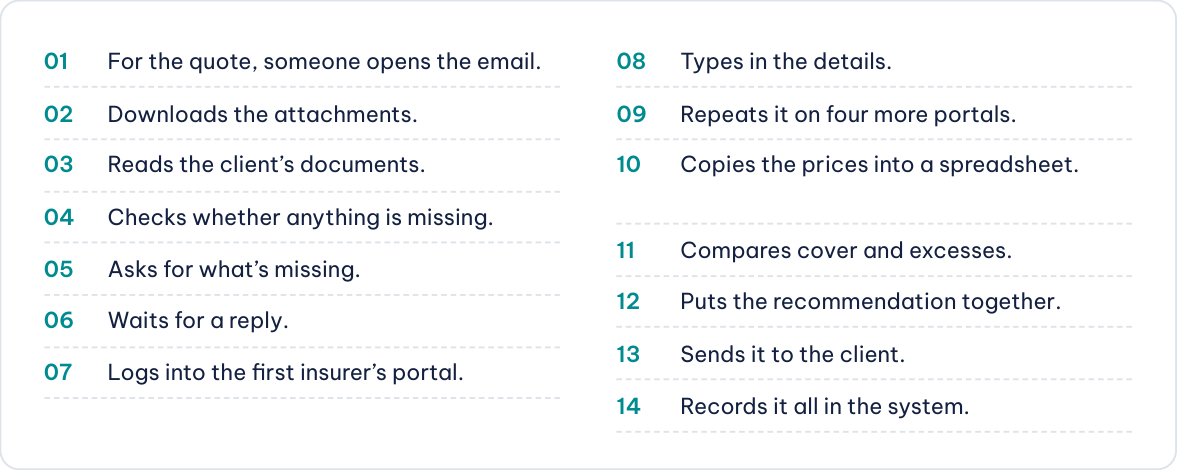
Software was there at every step. It didn’t do any of them. While this request is being handled, all the others wait.
What software has always done
Over the last two decades, broking technology has been designed to record and organise information:
Management system (ERP): the book, policies and contacts.
Insurer portals: data collection and processes such as quotes, policy issuance, mid-term adjustments and claims.
Email and phone: incoming requests and client communication.
Spreadsheets: analysing quotes and preparing recommendations.
Each tool covers part of the process. The integration between them is still done by people, who move data by hand from one system to another.
What agentic AI changes
Agentic AI refers to AI systems that can take a goal and carry it out end to end. The work is split across AI agents, each responsible for a specific task. The process stays the same, but the agents carry it out:
1. Read the client’s email and documents.
2. Check what data is missing, or move on if it’s all there.
3. Log into the insurer portals and request the quotes.
4. Analyse the quotes and prepare a document for the client.
5. Stop and ask the broker to approve before sending.
At the last step, the decision stays with the broker: the AI agents do the work, but no recommendation goes out without the broker’s approval.
| Traditional software | AI agents | |
|---|---|---|
| Role | Record, organise and remind | Carry out tasks end to end |
| The broker’s role | Operates the software | Oversees and approves |
| Information handled | Structured data, in fields | Emails, PDFs, images and messages |
| System integration | Manual | Automatic, over existing channels |
Why this matters now
A broker’s value has always been in the advice. Over time, the admin burden has crowded it out. By handing repetitive tasks to AI agents, brokers win back capacity for what sets them apart: risk assessment, advice and the client relationship.
The cost of standing still
The market is growing, but each broker’s slice is shrinking. Brokers earned €2,033 million in commission in 2024, 7% more than a year earlier.¹ In recent years, bancassurance has gained share, the register of intermediaries has shrunk and broking keeps consolidating.
Fewer intermediaries, year after year
In 2016 there were 77,556 tied agents on the DGSFP register; at the end of 2025, 50,530. In 2025 alone, the total number of intermediaries fell from 57,465 to 54,408. Brokers, who reached 3,721 in 2023, ended 2025 at 3,442, the lowest figure since 2018.¹
The 2020 insurance distribution law (Royal Decree-Law 3/2020) made compliance more expensive, with more training and more information for clients, and it weighs more heavily on small brokers.² Those left are the ones with scale, or the ones who will go looking for it.
Consolidation is speeding up in Spain
In 2025, 124 broker acquisitions were completed in Spain and Portugal, 18% more than in 2024.³ In Spain, most of the buyers are private equity-backed platforms. Sabseg, owned by Miura Partners, closed seven in 2025; PIB Group, backed by Apax and Carlyle, bought Bárymont and, in the second quarter of 2026, GGW’s Leading Brokers United brought in Grup Vila.⁴
A group that buys books inherits their culture, people and processes. A brokerage with tidy operations is worth more at the negotiating table. One that wants to stay independent competes with highly efficient groups.
Commission: the banks earn more
Average non-life commission in 2024: brokerages, 13.92%; tied bancassurance operators, 21.03%.⁵
And the cost of each policy isn’t falling. Every quote still eats up time across several portals, every renewal still calls for proactive contact, and every claim still needs following through.
Who is competing for the client
The threat isn’t insurers’ direct sales: their share fell from 18.4% to 18.0% of premiums in 2025.⁶ The threat is whoever already deals with the client every day.
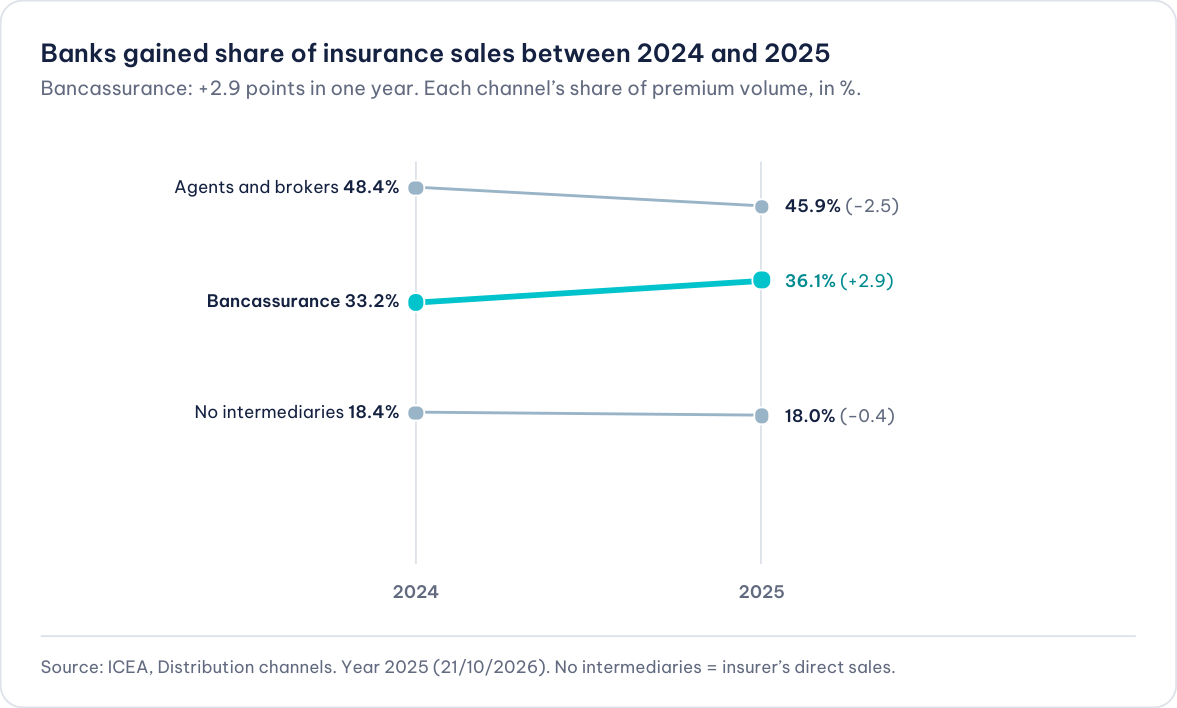
Bancassurance went from 33.2% to 36.1% of premiums between 2024 and 2025, and already takes 56% of new business and 63% of life business.⁶ Agents and brokers keep 63% of non-life, but lost share of the total.
The real cost: a less and less loyal book
Clients who can track a parcel on their phone in real time expect the same from their insurance. They want to know where their claim stands without having to call. They want to hear about their renewal before the payment reminder arrives.
Large broker groups and the banks share two advantages: efficient processes and the capacity to keep innovating. They respond faster, get ahead of renewals and offer a service that always feels up to date. Clients notice the difference, and they compare.
For brokers who keep their operations as they are, the cost doesn’t arrive all at once. It arrives as renewals that don’t come back, clients who start deciding on price and a book that grows less loyal. The relationship is still a broker’s biggest asset, but it is no longer enough when the service around it falls behind.
The AI landscape: four levels of integration
AI is already in almost every business, but rarely at its core. In 2025, 88% of organisations were using AI in at least one function. Only 39% saw an impact on results across the whole business.⁷
The difference between using AI and being transformed by it depends on your level of AI integration. At each level, AI knows more about the business, connects to more systems and takes on a bigger share of the work.
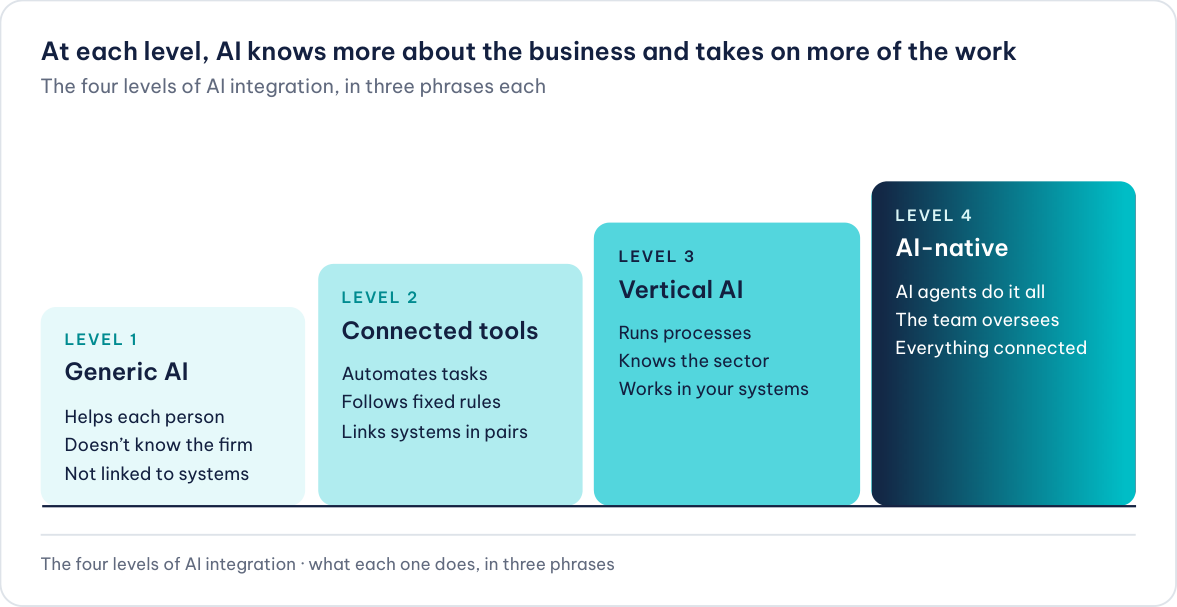
3.1 Generic AI: the same tool for everyone
The first level is the general-purpose assistant: ChatGPT, Gemini, Copilot, Claude. It’s the same infrastructure for everyone, from lawyer to student, from bank to restaurant.
The value is real and immediate. It writes an email in seconds, summarises a 40-page document, translates, prepares a meeting. In an accountancy firm, it drafts a reply to a client. In an online shop, it writes a product description. In a sales team, it summarises the morning meeting.
The limits are just as clear:
It doesn’t know the business. It doesn’t know who the clients are, what products or services the firm offers, or how it works.
It isn’t connected to your systems. All it knows is what someone has pasted into the chat, and everything it produces has to be copied back out.
It always starts from scratch. Each request is an isolated task, with no memory of the process it belongs to.
It raises data questions. Pasting client data into a public tool calls for care with GDPR and internal rules.
The result is individual productivity. Each person gets a little faster, but the process stays the same, and it still depends on whoever copies and pastes.
3.2 Connected tools: link parts of the business, never the whole
The second level adds external tools that connect systems to each other. AI, or simple automation rules, moves information from one place to another without manual input.
The most common categories:
Automation platforms (Zapier, Make, n8n): chain actions across apps. When something happens in one system, it triggers something in another, such as issuing a document, sending a reminder or updating a record.
RPA (UiPath, Power Automate): software bots that mimic a person’s clicks. They move data between systems that don’t talk to each other, always along the same path.
App connectors: off-the-shelf integrations that let the CRM, invoicing, e-signature or email share information without duplication.
Chatbots: on the website or in messaging apps, they answer frequently asked questions and collect the details of a request before it reaches a person.
The gain is tangible. Each connection removes a copy-and-paste task, and two or three well-chosen automations can save hours a week.
The limit is structural. Each tool handles one stretch of the process, never the whole thing. The automation sends the renewal notice, but doesn’t notice the client has changed car. The bot copies the premium from the portal, but doesn’t see that the excess has changed. The chatbot gives the claim status, but doesn’t know the client has already complained twice.
Between each link, there is still a person deciding the next step. And the exceptions, which in many businesses are the rule, always land back on someone’s desk.
For a broker with few lines of business and low volumes, this level may be enough: the connections pay off and the exceptions still fit into the working day.
3.3 Vertical AI: built for the sector, embedded in operations
The third level is AI built for a specific sector. It is a platform made for the business, and it works inside it.
Three capabilities set it apart:
It knows. It understands the sector’s documents, products, processes and rules. Nobody has to explain the jargon, the standard documents or each profession’s obligations.
It integrates. It connects to the infrastructure already in place: ERP, CRM, partner portals, email, WhatsApp. It works where the team works.
It executes. It uses AI agents to take a process from start to finish, with human approval at the points that matter.
Other sectors have already taken this path. In law, Harvey’s clients, Cuatrecasas among them, already run more than 25,000 custom-built AI agents.⁸ In healthcare, Abridge works inside the electronic health record at more than 300 health systems.⁹
The pattern repeats. General-purpose tools get a foot in the door, but the ones that stay know the trade, work inside existing systems and respect each profession’s rules.
In practice, it’s the difference between a tool that answers questions and one that knows the firm’s clients, products and partners, and acts on that knowledge.
3.4 AI-native: operations designed around AI agents
An AI-native business redesigns the way it works. AI agents run the processes; people oversee, advise and decide.
The difference lies in the starting question. At the other levels, the question is “Where can AI help?” Here, it is “Where are people unique, adding value no one can dispute?”
Very few businesses are fully AI-native today, but they are already on the horizon. OpenAI’s CEO, Sam Altman, has even said he expects one:
“[…] there’s this betting pool for the first year that there is a one-person billion-dollar company. Which would have been unimaginable without AI and now will happen.”¹⁰
It’s hard to imagine huge companies run by a single person, but we believe in a future where people have superpowers and reach goals and business volumes once out of reach.
The process is the same as at the previous levels, taken to its limit: AI agents that run processes, and others that coordinate them and are coordinated in turn, in a team of agents organised like a human team. The agent that prepares social media posts reports to the content agent, which reports to the marketing agent, which answers to management. Not every business or industry is built for this structure, and some areas can adopt it more easily than others. An agent acting as head of marketing doesn’t make that job redundant: iterating, approving and setting the course still call for human judgement, creativity and decision-making. So even in the businesses that go furthest, the starting question remains: where are people unique?
Some companies have already asked that question out loud. In March 2025, Shopify’s CEO wrote to the whole company that using AI effectively was now “a fundamental expectation of everyone”. Before asking for more people, every team must show why it can’t get the work done with AI.¹¹ And the company hasn’t slowed down: in 2025, Shopify’s revenue grew 30% to around $11.6 billion.¹¹
At Klarna, which closed 2025 with $3.5 billion in revenue and 118 million active consumers, the AI assistant handles around two thirds of customer service conversations. It resolves each one in two minutes, against 11 for a human, with the same satisfaction. At the same time, the company has gone back to hiring people for the more complex conversations, where knowing the customer well makes the difference.¹²
In both cases, being AI-native didn’t take people out of the process: it put them where they make the most difference.
In insurance broking, the answer to that question is advice, trust and the client relationship. Everything else can, step by step, move to AI agents.
The question is how far along that path your brokerage already is.
Where does your brokerage stand?
Five questions, five minutes, to find out your brokerage’s level of AI integration.
For each question, choose the answer closest to what happens today, not what is planned. A scores 1 point, B scores 2, C scores 3 and D scores 4.
1. How do you prepare a quote across several insurers?
A — Portal by portal, by hand. Sometimes we use ChatGPT or another AI to write the email to the client.
B — We use some automation, such as quote templates or data pulled from the management system, but every quote still involves several manual steps.
C — A specialist platform reads the documents, requests quotes on the portals and prepares the analysis and recommendation. We review and approve.
D — Quotes run with AI agents from request to recommendation. The team only steps in for exceptions, sign-off and advice.
2. How do you answer client requests by email and WhatsApp?
A — Each person replies from their own email and mobile. AI sometimes helps draft a reply.
B — We have automatic replies or a chatbot for the most frequent questions.
C — Requests arrive in a system that reads them, identifies the client and drafts the reply with context from the book. The team approves before sending.
D — Most requests are handled end to end by AI agents. The team takes the cases that need advice, and audits, oversees and trains the models.
3. How do you keep track of renewals and claims?
A — With the calendar, a spreadsheet or the memory of whoever handles the client.
B — The management system sends automatic reminders, but the work on each case is done by hand.
C — A platform prepares each renewal with price, cover and history, and keeps the client updated on claims. The team signs off.
D — Renewals and claims run with AI agents from first notice to close. The team steps in to negotiate and advise.
4. How do you decide where to use AI?
A — It’s up to each person. There are no rules and no plan.
B — We’ve picked a few tools for specific tasks, as needs arise.
C — We have a plan to move whole processes to AI, one at a time, with metrics for each.
D — Our operations are designed around AI agents. Before hiring, we ask what AI can do.
5. Where does the team spend most of the day?
A — On admin: portals, emails, documents and confirmations.
B — Some tasks have come off the to-do list, but the back office still dominates the day.
C — Part of the team has already moved from doing to overseeing and approving.
D — Most of the time goes on advice, sales and client relationships.
Your score
| Score | Level | What it means | Where to start |
|---|---|---|---|
| 5–8 | 1 Generic AI | AI helps people, not processes. Operations depend on whoever copies and pastes. | Measure your most time-consuming process. |
| 9–12 | 2 Connected tools | There is some automation, but each piece handles one stretch. Exceptions go back to the team. | Move a whole process, such as quotes, to a vertical AI. |
| 13–16 | 3 Vertical AI | Key processes already run with AI agents, with human approval. | Extend to other processes and redesign team roles. |
| 17–20 | 4 AI-native | Operations run on AI agents. The team is where it makes the most difference. | Use the time freed up to create new client services. |
The total gives your level. The answers, one by one, are the map: a question that scores lower than the others is almost always where the biggest opportunity lies.
What changes in your operations
Saturday, 11pm. The phone rings. It’s a client of 15 years: the storm has flooded his basement and the water has reached the fuse box. He doesn’t care about the policy number. He wants to know what to do now, and he wants to hear it from someone he trusts.
Moments like this are why brokers exist. Whatever the level of AI integration, this part of the job doesn’t change.
5.1 What stays human: advice, trust and the relationship
Clients want technology and a person at the same time. The latest surveys show it.
In a study of 4,000 adults in the US, the UK and Australia, 88% preferred to get insurance advice from a person.¹³
In Spain, 45% of consumers who bought insurance in the last two years did so only through an agent or broker, in person or by phone. Only 20% bought exclusively online.¹⁴ And when AI takes over the process on its own, distrust sets in: 47% of Spanish policyholders would not accept a claim being handled with no human involvement, and 44% want to be able to turn to a member of staff if they disagree with an AI decision.¹⁵
The numbers bear out the Saturday-night scene: clients accept technology behind the scenes, and even waiting, but want a person in front when a decision is hard or something goes wrong.
This defines what stays with the broker:
Advise. Understand each client’s real risk; recommend the right cover, not the cheapest.
Be there. See clients through a claim: explain, reassure, fight their corner with the insurer.
Build trust. Keep up a relationship over years, which no comparison site and no AI agent can replace.
Decide. Take responsibility for what is recommended and sent in the brokerage’s name.
Oversee and train. Monitor the AI agents’ work, correct what goes wrong and train them on the brokerage’s rules and know-how.
None of this shrinks with AI. When AI agents take on the repetitive tasks, brokers have time to do more of what clients value.
5.2 Automation: the non-negotiable baseline
Automation has become a condition for competing. The banks and large broker groups are cutting the cost of every policy with increasingly automated processes. Those who don’t keep up pay more for the same work and respond more slowly to the same client.
The way forward depends on the level each brokerage is at today:
| Level | Already automated | Next opportunity | Practical examples |
|---|---|---|---|
| 1 Generic AI | Text and summaries, person by person | Automate one process end to end | Motor quotes end to end; Insurance certificates and policies read automatically; Emails sorted by client and request |
| 2 Connected tools | Standalone tasks: reminders, templates, auto-replies | Join the pieces into one process | Renewals that arrive with terms ready; Overdue premium reminders tailored to each client; Mid-term adjustments via WhatsApp |
| 3 Vertical AI | Key processes with AI agents and human approval | Extend to more lines and processes | Claims followed from first notification to close; Health, home and personal accident quotes; Policies issued and sent with no manual steps |
| 4 AI-native | Operations run on AI agents | Turn the time freed up into service | Annual review of every client’s policies, with cross-selling; Claims experience reports for business clients; A team dedicated to advice |
At every level, the gain is tangible: quotes in minutes, renewals that don’t slip through the net, fewer keying errors and a team that no longer spends the day on portals.
Clients get their quotes faster, and that matters, but the experience still looks much like any other brokerage’s. And as the technology becomes widespread, speed stops setting you apart: it becomes the minimum clients expect.
5.3 Service is the differentiator
In most lines of business, brokerages sell the same products from the same insurers. To the client, one brokerage’s motor policy is the same as the one next door. What changes is what happens around it.
Today, that experience is much the same almost everywhere. The client asks, the brokerage responds. The policy is issued and the next contact comes at renewal, or when there is a claim.
Staying close to every client on a regular basis has always taken more hours than the book can pay for. So it was kept for the biggest clients, or simply not done.
AI changes the maths. When AI agents handle the repetitive work, a service that used to be expensive becomes possible for the whole book:
Reach out first. Talk to clients before they need to call.
Personalise. Tailor cover and messages to each client’s life, not just to the line of business.
Show value between renewals. Make clients feel the brokerage is there all year round.
Automation keeps a brokerage competitive. Whether it keeps being chosen depends on the service it builds with the time it gains, and on building it before the others do.
If your team had 10 more hours a week, what new service would you offer your clients? The next section suggests six answers.
New client services: six examples
Six services that automation already makes possible for the whole book, not just for the biggest clients. In each one, AI agents handle the groundwork and the broker keeps the part the client values.
6.1 Claims alerts
The client gets: a message as soon as the claim is logged, with the next steps and the contact details of whoever is handling it.
The AI agents: pick up the claim notification, request missing documents and send an update at every change of status.
The broker: calls in serious cases and fights the client’s corner with the insurer.
6.2 Proactive renewals
The client gets: a review of cover and price before renewal comes round, with alternatives where they make sense.
The AI agents: identify renewals due, request alternative quotes and prepare the analysis and recommendation.
The broker: recommends and explains the choice.
6.3 Life events
The client gets: a review of their cover when they move house, have a child or retire.
The AI agents: spot these signals in the client’s messages and data, with their consent, and prepare a suggested review.
The broker: has the conversation, which needs a human touch.
6.4 Cover gap review
The client gets: a clear, prioritised list of the risks that aren’t covered.
The AI agents: match each client’s policies against their profile and flag what’s missing.
The broker: decides what to recommend and when.
6.5 Risk alerts
The client gets: a warning before a storm or heatwave, with advice on protecting their home or business.
The AI agents: match weather warnings against insured addresses and send the right message to each client who has opted in to these alerts.
The broker: follows up with the most exposed clients.
6.6 Reports for business clients
The client gets: a regular claims experience and risk report, with recommendations.
The AI agents: gather claims and policy data and build the report.
The broker: presents it to the client and turns it into a risk improvement plan.
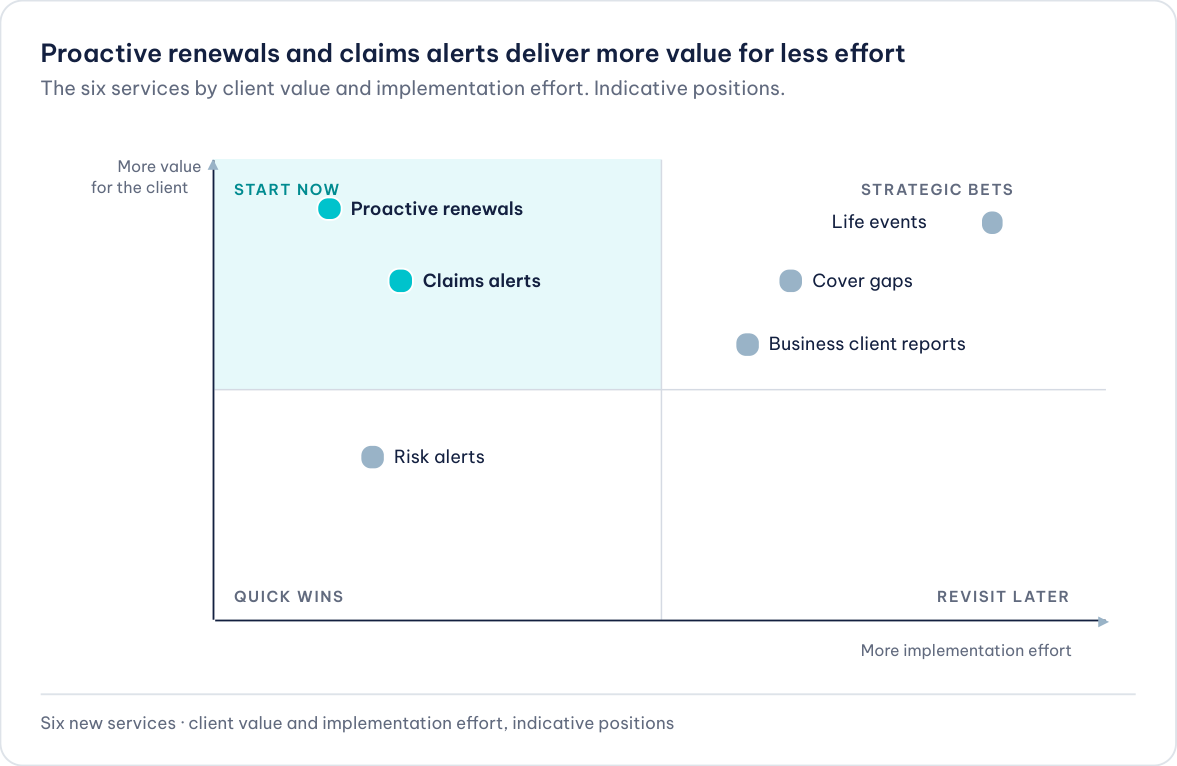
Proactive renewals and claims alerts are the natural starting point: clients feel the difference straight away, and they build on processes the brokerage already runs. Life events and cover gaps need more data and more maturity, but that is where the greatest long-term value lies.
Putting it into practice
Six months is enough to go from the first automated process to the first new service.
Start with one process, measure it, and only then extend.
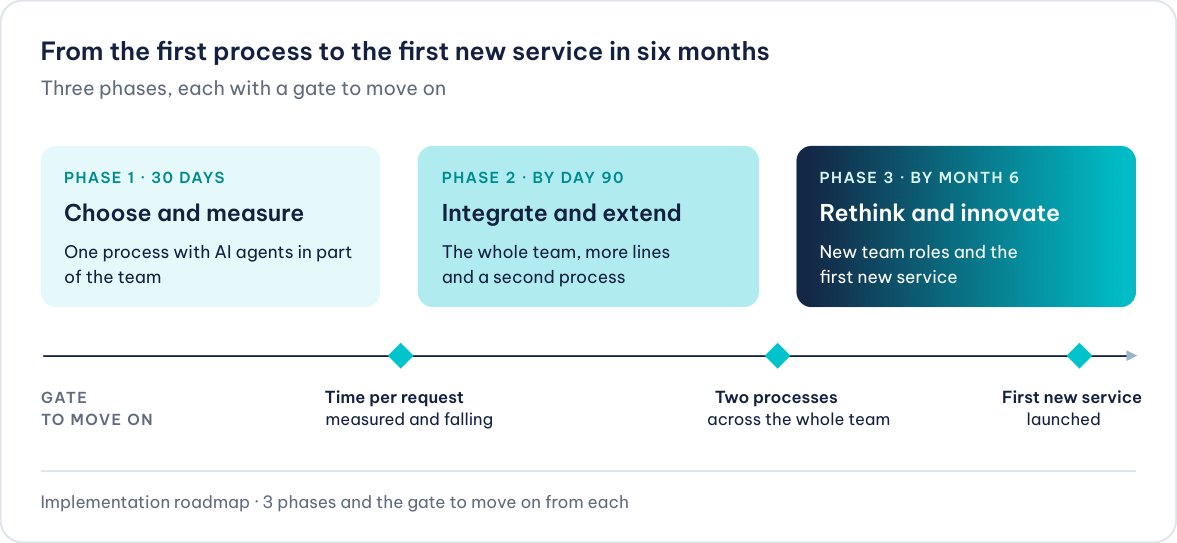
Phase 1 · first 30 days — Choose and measure
Choose a high-volume, repetitive process, such as motor quotes or renewals.
Measure the starting point: time per request, client response time, errors.
Run it with AI agents in part of the team, with approval at every step.
Phase 2 · by day 90 — Integrate and extend
Extend the process to the whole team and the main lines of business.
Add a second process, such as claims or client communication.
Review the metrics every month and adjust the approval points.
Phase 3 · by month 6 — Rethink and innovate
Reallocate the time freed up: less back office, more advice and sales.
Launch the first new service from the section 6 matrix.
Decide who in the team oversees the AI agents, and under what rules.
Integration: working with what you already have
There’s no need to change your management system or ask insurers for integrations. Vertical AI works on top of the infrastructure the brokerage already uses: the ERP, insurer portals, email and WhatsApp. It replicates what a person does: it goes to the same places as the team, with the same login credentials and the same rules, and with security safeguards in place.
That speeds up implementation and keeps the relationship with each insurer exactly as it is.
AI agents work within clear limits designed to prevent critical errors, and each process sets where a person must step in. Several insurers have already approved this way of working.
How team roles change
| Today | With AI agents |
|---|---|
| Filling in portals and copying data | Reviewing and approving what the AI agents have prepared |
| Answering requests as they come in | Handling the cases that need advice or negotiation |
| Tracking renewals and claims by hand | Looking after the most exposed and highest-value clients |
| Little time for clients | Time to advise, sell and design new services |
The aim isn’t to shrink the team. It’s to change what each person does day to day, and whoever did the most repetitive work is usually the first to feel the relief.
Case study: redesigning operations in practice
A national broker decided to redesign its entire operation, rather than automate isolated tasks. It set concrete metrics and mapped out the path: where to start, what changes at each step and how progress is measured.
What we already measure
Two brokers who have been using the platform at a mature level for several months provide the benchmark. Between May and July 2026, each ran between 8,200 and 9,500 quotes a month with AI agents. In that process alone, each avoided between 610 and 710 hours of manual work a month, the equivalent of four to five full-time staff.¹⁶
For a smaller broker, the maths works the same way: every 100 quotes equal around 7.5 hours of manual work avoided.
And that’s just quoting: premium collection, claims, renewals and cross-selling are outside this calculation, and that’s where most of the value lies. At the broker in this case study, results are still being measured.
The client
An insurance broker with a nationwide presence, several offices, a customer service centre and thousands of clients. It had already been using AI agents for motor quotes for several months.
The challenge
More than half of each team member’s day went on operational tasks.
Several offices sent requests by email, phone and WhatsApp, with no shared queue.
The same data was re-keyed into each insurer’s portal.
Statements were downloaded portal by portal and reconciled by hand at month end.
Claims were followed up by email, one by one.
Management asked to rethink operations as if they were designed today, starting with premiums and reconciliation, claims, renewals and an operational view built from ERP data.
The objectives
The project set a two-year objective: an operation where operational tasks take up less than 10% of the day, AI agents do the work on insurer systems and every team member focuses on clients. The change happens process by process, with human sign-off at the last step and without disruption for clients or the team.
| For | Objective |
|---|---|
| Clients | A reply within minutes on any channel; policies reviewed at every renewal; claims followed up within hours |
| Team | No data re-keyed into portals; the day devoted to relationships, advice and decisions |
| Managers | The same processes in every office, including new ones; operational KPIs always up to date |
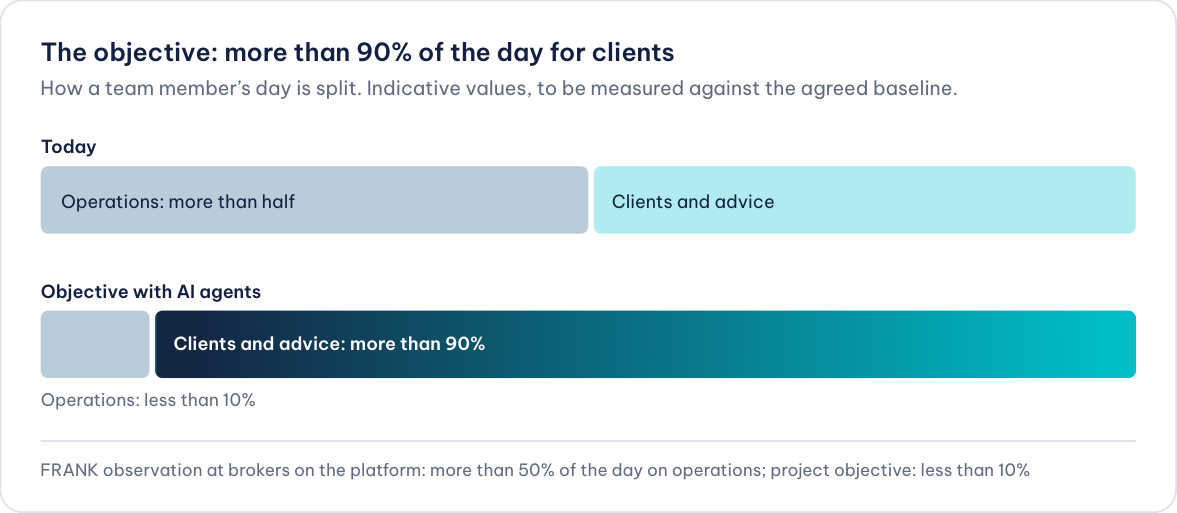
The solution: before and after
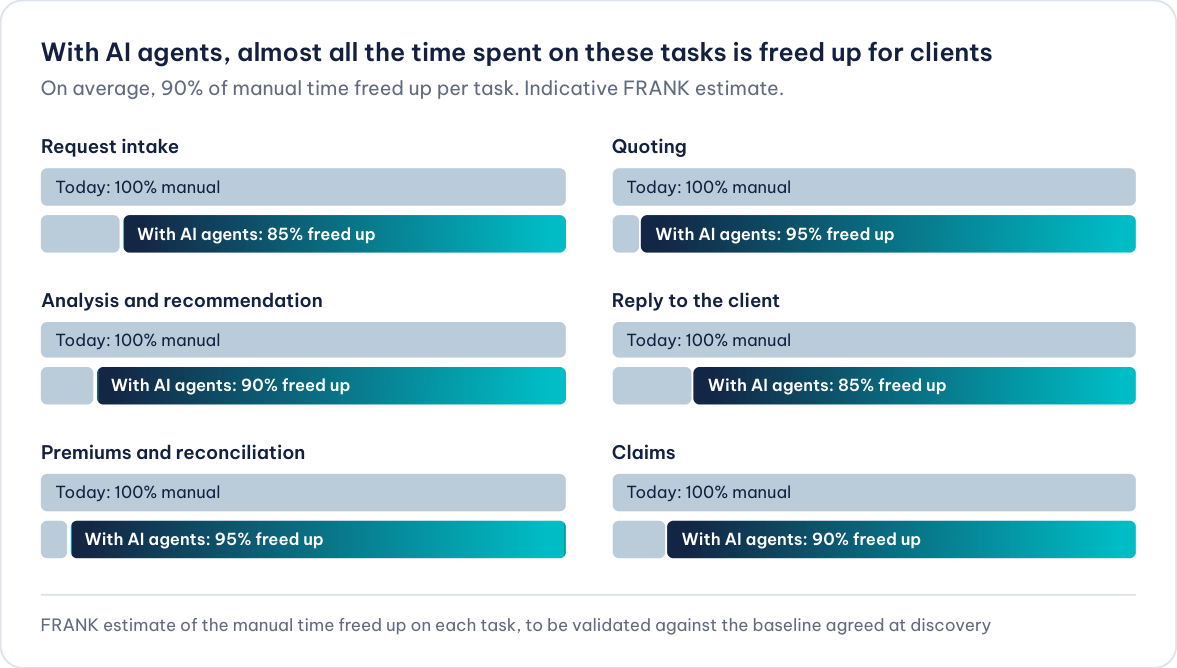
Operations on day one
A request comes in on any channel and is completed on insurer systems, with a person signing off the last step. Each party keeps its role: the AI agents run the middle of the chain, insurers keep the product, the risk and the claims decision, and the broker decides and signs.
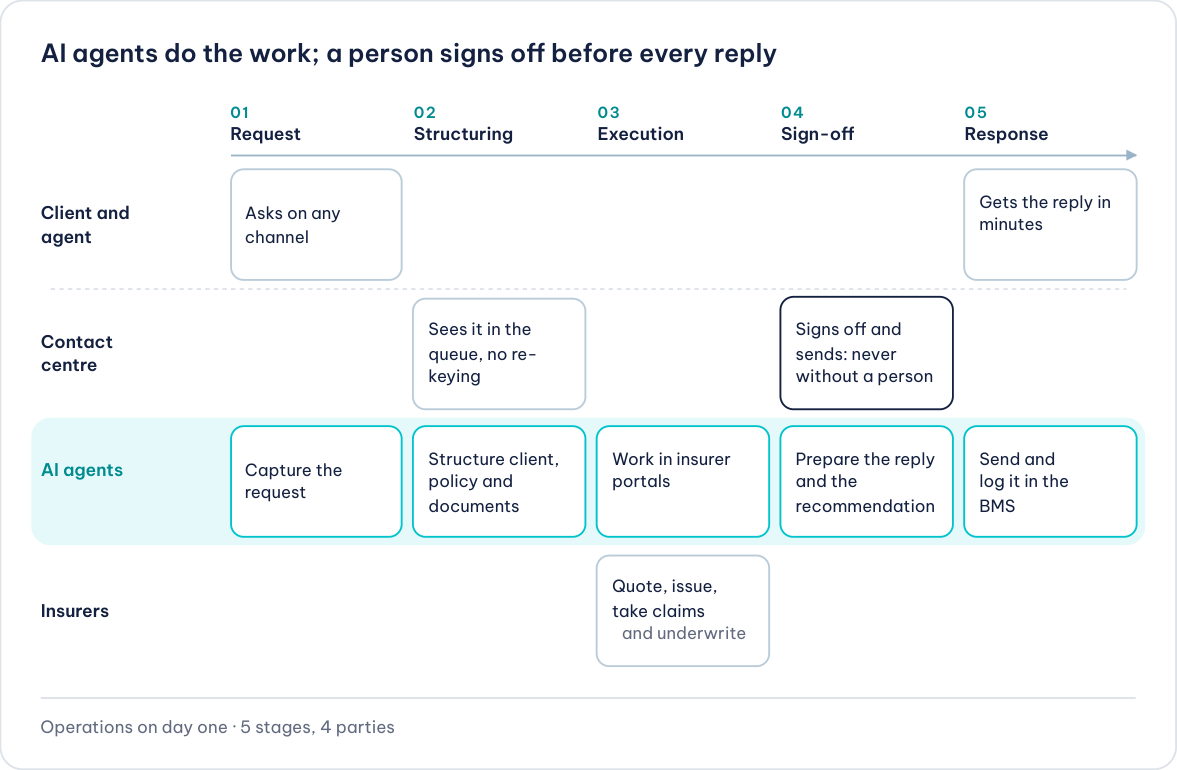
At launch, four processes were already available with AI agents: quoting, policy issuance, claims and renewals. The rest come in by order of value.
How the project moves forward
The project moves forward in quarterly cycles. In each cycle, the two teams map processes and volumes, set priorities by value and effort, build the AI agents from recordings that each team member chooses to make, test them on real cases and measure hours, revenue and response times against the agreed baseline.
The review at the end of each cycle decides the next step on a two-year roadmap, which only moves forward as far as the results justify: first premium collection and reconciliation and a single request queue, then claims, renewals and a single view of each client across the whole network, and finally new channels and offices using the same processes from day one.
The end client always sees the broker’s brand, on every channel. The AI agents work behind the scenes, and nothing goes out without a person’s sign-off.
How success is measured
| KPI | What it measures |
|---|---|
| Time per request | Minutes from request intake to a reply ready for sign-off |
| Client response time | Hours from request to reply sent |
| Automation success rate | Requests completed by AI agents with no manual intervention |
| Hours freed up per person | Manual work avoided, per month |
| Share of the day on operations | Part of the day spent on operational tasks |
| Renewal retention | Policies renewed out of those due |
| Cross-selling | Policies per client |
| Satisfaction | Of the team and of clients, measured each cycle |
Conclusion: the broker’s comeback
Monday, 9am
The three renewals due this week already have terms prepared, with alternative cover and assistance options. The claim has the documents it needed and the client got an update on Saturday. The quote request that came in on Sunday is ready for sign-off.
The broker starts the day with a short list of decisions and two calls to make. One is to the client who has moved house. The other is to a business whose claims experience has worsened and which needs a risk improvement plan.
None of this takes a bigger team. It takes handing back-office work to whatever does it better and faster, and putting the time left over back where broking has always had its value: advice.
Three steps to get started:
Find out where you stand. The five questions in section 4 show your level of AI integration.
Start with one process. Choose the most time-consuming one, measure the starting point and run it with AI agents.
Turn time into service. Use the hours freed up for a new service your clients will notice.
Broking has always been a trade built on trust. AI agents clear everything else out of the way.
Next step
Book a 30-minute assessment with the FRANK team. Together we’ll review your self-assessment score, pinpoint the process with the most potential in your business and map out your first 30 days.
info@meet-frank.com · frankinsurance.ai
About FRANK
FRANK is the AI Operator for insurance brokers. Its AI agents carry out a brokerage’s operational work, from quote to renewal, in the systems and portals each broker already uses, and always leave the decision with a person. In September 2026, the platform served more than 350 brokers and agencies, with more than 1,500 users and more than 80,000 tasks a month.¹⁷ Authors: The FRANK team.
Sources
1. DGSFP, Sector report 2025 https://dgsfp.mineco.gob.es/es/Publicaciones/DocumentosPublicaciones/Informe%20del%20sector%202025.pdf, and 2016 report https://dgsfp.mineco.gob.es/es/Publicaciones/DocumentosPublicaciones/Informe%20de%20Seguros%20y%20Fondos%20de%20Pensiones%202016.pdf; INESE, Brokers’ commission income rises 7% in 2024 https://www.inese.es/los-ingresos-por-comisiones-de-los-corredores-suben-un-7-en-2024/.
2. Pérez-Llorca, Mergers and acquisitions (M&A) of insurance brokerages in Spain: trends and state of the sector in 2025 https://segurosnews.com/wp-content/uploads/2026/01/Tendencias-en-fusiones-y-adquisiciones-de-corredurias-de-seguros-en-Espana-en-2025.pdf, January 2026.
3. INESE, Insurance broker mergers and acquisitions in Iberia grow 18% in 2025 https://www.inese.es/las-fusiones-y-adquisiciones-en-brokers-de-seguros-en-iberia-crecen-un-18-en-2025/, 17 March 2026.
4. MarshBerry, Q2 2026 Spanish Insurance Distribution M&A https://www.marshberry.com/eu/blog/q2-2026-spanish-insurance-distribution-ma-consolidator-competition-is-intensifying/, 13 July 2026; Expansión, Broker acquisitions hit a record in 2025 https://www.expansion.com/empresas/seguros/2026/04/01/69cc50a6468aeb751f8b45a7.html, 1 April 2026.
5. DGSFP, Sector report 2025, part three, “Insurance distribution”: average commission reported by brokerages and tied bancassurance operators, 2024 financial year.
6. ICEA, Bancassurance was the distribution channel that grew most in premium market share in 2025 https://www.icea.es/es-ES/noticias/Noticias/Noticias1026/Dia-21/bancaseguros.aspx, 21 October 2026, and the report Distribution channels. Year 2025.
7. McKinsey, The state of AI in 2025: Agents, innovation, and transformation https://www.mckinsey.com/capabilities/tech-and-ai/our-insights/the-state-of-ai-2025, November 2025, survey of 1,993 participants in 105 countries.
8. Harvey, Harvey raises growth round at $11 billion valuation, co-led by GIC and Sequoia https://harvey.ai/blog/harvey-raises-growth-round-at-dollar11-billion-valuation-co-led-by-gic-and-sequoia, 25 March 2026.
9. HLTH, Abridge expands clinical intelligence AI across 300 health systems https://hlth.com/insights/news/abridge-expands-clinical-intelligence-ai-across-300-health-systems, 18 August 2026.
10. Fortune, Could AI create a one-person unicorn? Sam Altman thinks so https://fortune.com/2024/02/04/sam-altman-one-person-unicorn-silicon-valley-founder-myth, 4 February 2024, from Sam Altman’s interview with Alexis Ohanian.
11. Fortune, Shopify CEO says no new hires without proof AI can’t do the job https://fortune.com/2025/04/08/shopify-ceo-ai-automation-no-new-hires-tech-jobs/, 8 April 2025; Digital Commerce 360, Shopify revenue and GMV, Q4 2025 https://www.digitalcommerce360.com/2026/02/17/shopify-revenue-gmv-q4-2025/, 17 February 2026.
12. CMSWire, Klarna CEO: we’re giving AI more customer service work, not less https://www.cmswire.com/contact-center/klarna-ceo-were-giving-ai-more-customer-service-work-not-less/, 20 May 2025; Klarna, Klarna Group plc Publishes Full Year 2025 Results https://www.businesswire.com/news/home/20260226134670/en/Klarna-Group-plc-Publishes-Full-Year-2025-Results, 26 February 2026.
13. Insurance Business, Consumers prefer human insurance advisors, but AI adoption grows https://www.insurancebusinessmag.com/au/news/cyber/consumers-prefer-human-insurance-advisors-but-ai-adoption-grows-507942.aspx, 2 October 2024. UserTesting study of 4,000 adults in the US, the UK and Australia.
14. EIOPA, Flash Eurobarometer: Consumer trends in insurance and pension services, Spain factsheet https://www.eiopa.europa.eu/document/download/27c30f41-430d-44dd-969f-3ce0129e3084_en?filename=fl_EIOPA_fact_ES_en.pdf, 1,015 interviews in Spain, May 2025.
15. Guidewire, Guidewire study: only half of pet owners in Spain have insurance https://www.guidewire.com/es/about/press-center/press-releases/20260520/solo-la-mitad-de-los-propietarios-de-mascotas-en-espana-tiene-contratado-un-seguro, 20 May 2026. Guidewire European Insurance Consumer Survey 2026, Spain results.
16. FRANK platform data, two brokers with mature usage, May to July 2026. Calculated at 4.5 minutes saved per quote and 147 working hours per person per month.
17. FRANK platform metrics, September 2026.