
From Steel Frames to Lego Bricks
How generative AI, robotics and modular design transform insurance workflows, empower brokers and deliver faster, more personalised service.
· FRANK · English
Download PDFHow AI is transforming the insurance industry, an industry based on unstructured data and extensive documentation, enabling standardization and automation of workflows, delivering a faster and more efficient service.
Abstract
The insurance industry is undergoing a paradigm shift, as technology is moving away from rigid systems (“steel”) toward AI-driven modular software (“legos”). Just like structural steel allowed the construction of the Home Insurance Building in Chicago, completed in 1885, widely considered the first skyscraper and the first building to utilize a steel frame, digitalization has enabled several industries from ecommerce to media, and it funneled innovation in insurance through comparison websites and direct to consumer insurtechs.
While efficient at large scale, hard technology like steel or services digitalization is expensive to develop and difficult to customize, thus becoming inefficient when applying to highly customizable and unstructured products and services such as insurance.
Insurance is often a basket of random bricks – of customer insights and data, intermediated distribution, varied underwriting models, operational rules and workflows, and regulatory frameworks. Given the specificities of the industry, technology, as a tool, is most efficient once it becomes modular, accommodating the variability of characteristics across products, processes, carriers and countries.
Lego bricks drive one’s imagination - start with a large basket of random bricks and build a robust, creative and beautiful structure out of it. Similarly at Ikea, customers pay to build blocks together, benefiting from affordable, transportable, inexpensive and modular products.
In most markets, insurance incumbents and insurtechs have struggled to digitalize their entire range of products and services at large scale through traditional technologies. These were not effective to operate data when it wasn’t structured, nor profitable to develop when the scale of the use case wasn’t big enough. Thus, in most insurance markets, traditional methods and actors persist.
Previous technological shifts have dramatically transformed the financial sector. For example, electronics has changed how we process payment operations from a pure manual and in-agency operation to an online commodity, allowing banks to focus on higher value-add banking services.
This whitepaper examines how generative AI, robotics and modular design are transforming insurance operations. We outline the strategic need for AI in an industry defined by complex, variable workflows, and highlight case studies of AI innovators and projects—ranging from startups like Further AI, Little John and FRANK. We discuss how these AI solutions automate operations, distribution, underwriting, claims processing, and compliance, yielding faster operations, fewer errors, and more personalized customer experiences. Recent research from leading institutions (Stanford, MIT, Cambridge) and industry surveys have been incorporated to underscore trends and best practices.
The analysis concludes with key benefits of AI adoption and a forward-looking outlook, emphasizing that insurers who embrace modular AI technologies today will gain agility, efficiency, and competitive advantage in the evolving landscape.
1. Introduction – From Steel to Legos
Traditional technology stacks have long been closed systems, with each technology block being inflexible and incapable of dealing with information that the system was not built to deal with. While this “large steel structure” approach worked for industries with standardized and highly repetitive processes (e.g. e- commerce checkout), it struggles in insurance’s diverse environment. Insurance products vary widely in risk assessment, onboarding, documentation, regulatory compliance, and customer interaction and servicing. A one-size-fits-all platform has been rather difficult to develop, in contrast to other successful digitalized sectors like e-commerce (e.g. Amazon) or even personal banking (e.g. Revolut).
Digitalized insurance workflow
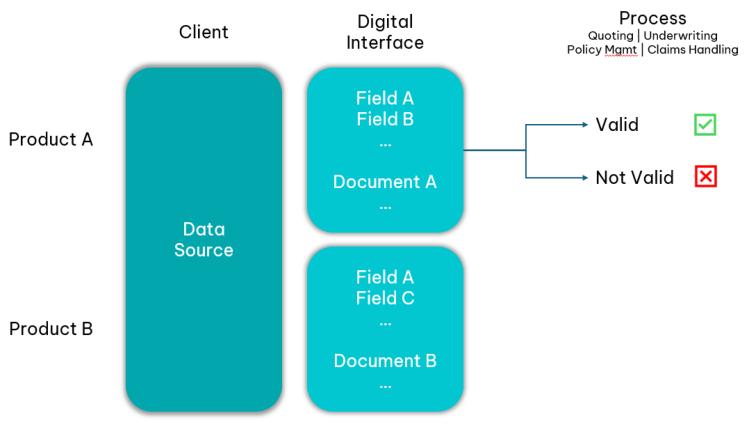
Source: FRANK Intelligence
Given the inelasticity of these interfaces and the respective required investment, successful digitalized insurance operations have been rather the exception. To deal with the sectors workflow complexity, traditional agent and brokers have continued to be the ideal and mainstream channel to process core insurance operations – finding the right product schema that fits each specific underwriting profile, manage policy administration, or deliver clarity and piece of mind during a claims process.
Generative AI is enabling a transition from steel-software to modular “legos”, by understanding context in unstructured data (conversations, documents, policies, etc.) and allowing to structure these inputs into reliable and scalable systems. Insurance players can now benefit from AI-driven modules for each function — quoting, underwriting, policy administration, claims, support— creating agile workflows that adapt to each product’s requirements.
This modular approach, powered by AI, underpins a new era of insurance innovation.
2. The Strategic Necessity of AI in Insurance
Complexity and Variation: Insurance is uniquely complex and personalized. Each line of business—auto, property, health, life, commercial—has distinct processes for onboarding, KYC, underwriting, compliance, and claims. Workflows vary between product lines, insurance carriers and countries. Each insurance portal UX is different. Regulations also evolve frequently, and interpretations and prioritization of these often vary across industry players. Human-driven, manual processes in these areas are time consuming and error-prone. Rigid systems can’t easily accommodate the variation in, say, a simple auto policy vs. a complex cyber insurance policy. This complexity makes insurance a prime candidate for AI-driven improvement. According to a McKinsey report, adopting generative AI can enable highly customized product offerings and automate routine tasks, alleviating the strain of complexity.
Modern Customer Expectations: Today’s customers expect fast, digital-first service—onboarding in minutes, fast quotes, and swift claims settlement. While personalized human insurance advisory is still highly demanded, traditional operational methods (paper forms, phone calls, week-long underwriting) underdeliver on these expectations notably because they have limited workflow integration capabilities, requiring time and prone to error throughout the workflow delivery. AI provides natural language interfaces – seamless integrated to traditional channels – standardize information, handle customer interactions 24/7 and process requests immediately. It can analyze customer data to personalize recommendations, mirroring the on-demand, personalized service people get in other industries.
Data-Driven Decision Making: Industry actors have vast data (conversational content, historical claims, telematics, IoT, social, etc.) that can improve decisions if analyzed properly. AI systems can crunch these large datasets far better than manual reviews, finding patterns to inform risk selection, pricing, and fraud detection. Accurate, real-time decisions are increasingly necessary – for example, flagging a suspicious claim out of thousands filed in a day, or adjusting pricing as new risk factors emerge. Generative AI can even simulate scenarios (e.g. catastrophic event impacts) to help in risk management planning. Researchers at Cambridge University’s Centre for Risk Studies have begun leveraging generative techniques to create realistic risk scenarios, partnering with Lloyd’s of London to model complex systemic risks.
Competitive Pressure: AI is no longer optional – it’s becoming critical for insurers to keep pace with industry innovation. A Stanford study notes that 78% of global enterprises had deployed AI in workflows by 2024, up from 55% just a year earlier. The insurance industry, historically conservative, is now among those accelerating AI adoption.
In summary, AI addresses the strategic pain points of insurance: it handles complexity with adaptive solutions, meets customer demand for speed, harnesses big data for insight, and wards off competitive disruptors. Insurers that strategically implement AI can expect improved agility, cost savings, and customer loyalty.
4. Case Studies & Use Cases: AI Innovators Transforming Insurance
To illustrate the real-world impact of AI in insurance, we examine several innovators and projects applying AI “lego blocks” in different domains of insurance:
• Further AI – AI Teammates for Underwriting and Claims: Further AI is a San Francisco-based insurtech providing an AI platform for commercial insurance operations. Their solution acts as a “workforce of AI teammates” that automate complex workflows like submission intake, policy comparison, underwriting audits, and claims triage. The company emphasizes that AI is augmenting human underwriters, not replacing them – by handling the drudgery of data entry and initial analysis, it frees human experts to focus on judgement calls and complex cases. The company’s success attracted $5M in recent funding.
• FRANK – AI & Robotics Platform: FRANK works as an insurance agent assistant that automates daily tasks. It automates key aspects of the advisory process: generating insurance quotes across carriers, collecting customer information, and analyzing and assisting agents and their clients. It offers a team of robots, enabling to produce multiple tasks in minutes simultaneously – a task that often takes human agents hours. FRANK is backed by the Insurtech-specialist Venture Capital fund Start Ventures, investor of successful insurtechs such as Coverflex or Habit. FRANK’s team has long experience in the sector through Lovys and Element, and in AI and in software powerhouses like FiveAI, SAP and Accenture.
• Little John – Generative AI Assistant for Insurance Brokers: Little John is a Paris-based insurtech startup (founded 2024) building a generative AI platform to empower independent insurance brokers. Brokers, especially in commercial insurance, juggle tasks from finding the right coverage in the market (risk placement) to ensuring compliance and handling administrative paperwork. For example, the GenAI-powered tool can read incoming client emails and documents, extract key data, and automatically draft personalized insurance proposal notes. After securing €1.1M in pre-seed funding, Little John is launching its SaaS platform in 2025 with a community of brokers piloting the solution.
Each of these cases demonstrates different facets of AI’s transformative role: Further AI shows backoffice underwriting automation, Little John exemplifies AI assisting front-line intermediaries and FRANK streamlines insurance agencies. Common threads include significant efficiency gains, better accuracy, and improved service quality. These innovators also illustrate that AI in insurance is not a one-size solution but a toolkit of modular services – one that can be productized (as startups do) or internally developed to fit specific strategic needs.
5. AI Empowerment of Insurance Agents and Brokers
Rather than viewing AI as a threat, many players are finding it to be an empowerment tool for their human workforce. Insurance agents and brokers augmented with AI become “super-agents” – able to handle more clients with greater quality of service. Here’s how AI is changing the day-to-day work of insurance professionals:
• Offloading Administrative Burden: Agents typically spend a large portion of their day on paperwork – entering client details into systems, generating quotes, processing changes, checking policy documents, and ensuring compliance forms are in order. AI-powered assistants now handle much of this. For example, when meeting a new client, an agent can use an AI tool to automatically gather the client’s information (from IDs or previous records), run required compliance (KYC/AML) checks, and even pre-fill application forms. Little John’s broker assistant and FRANK’s agent platform both exemplify this offloading.
• Enhancing Expertise: AI systems can serve as on-demand expert references, helping agents answer complex questions. For instance, an AI knowledge base trained on an insurer’s underwriting guidelines and past cases can assist an agent in real-time if a client asks a nuanced question about coverage or exclusions. Rather than saying “I’ll get back to you,” the agent can retrieve an immediate, accurate answer from the AI.
• Deeper Client Relationships: With routine tasks handled by automation, agents have more time to interact meaningfully with clients. They can schedule more frequent check-ins, conduct detailed coverage reviews, and proactively reach out with advice (e.g., suggesting a policy adjustment when life events or market conditions change).
• Scalability and Consistency in Service: Firstly, AI systems that enable human-in-the-loop and have solid QA systems allow a full control of the operation, thus enabling on one hand to control for quality and on the other hand to improve the model by correcting mistakes perpetually. Secondly, a junior broker with an AI assistant can perform better and learn faster at many tasks, because the knowledge and processing power of the organization’s best practices are embedded in the tools they use. This helps standardize quality of service across an agency.
Industry analysts note that these improvements can yield up to a 40% boost in productivity for insurance frontline. In one study, a mid-size brokerage that implemented an AI assistant saw their brokers able to handle 1.5× the number of clients on average, while improving policy renewal rates, thanks to the timely interventions prompted by AI (Accenture, 2023).
It’s important to highlight that AI is enhancing human roles, not replacing them: the trust, empathy, and nuanced judgment of human advisors remain irreplaceable. But by automating drudgery and providing intelligent support, AI allows those human qualities to shine through in every client interaction. This synergy of human + AI is emerging as a winning model in modern insurance distribution.
7. Challenges and Future Outlook
The transition to AI-driven, modular insurance is well underway, but it comes with challenges that industry players must manage proactively.
The main challenge expected is not a technological one: change management. The industry is human-intensive, adapted to traditional ways of working and rigid cultures. Those able to adapt faster to the new world of possibilities will succeed in capturing the business opportunities that arise from these new technologies.
Data privacy and ethics are paramount concerns. Insurance data is highly sensitive, and generative AI systems must be designed to protect personal information and avoid bias. A 2024 MIT Sloan–BCG study found that most organizations are not fully prepared for the risks of third-party and generative AI, with significant gaps in governance and oversight. The insurance industry echoed these concerns: in the SAS survey, 59% of insurance executives were worried about GenAI’s ethical implications, higher than other sectors, yet only 5% said they had a well-established AI governance framework.
Despite these challenges, the future outlook for AI in insurance is exceedingly positive. The industry’s shift from rigid “steel” to flexible “legos” is expected to accelerate as technology matures.
In the near term (next 2–3 years), we can expect:
• Broader Adoption of Generative AI for customer-facing tasks, like policy drafting and answering complex customer queries in natural language. We may see AI robots or “co-pilots” along the entire insurance value chain, integrated into the existing workflows and tools.
• AI-enabled insurance services: beyond underwriting and claims, into operations, traditional distribution, fraud detection and investment management.
• Collaboration and Ecosystem Growth: traditional brokers, agents and insurers might increasingly partner with insurtech startups, creating an ecosystem of shared AI solutions.
• Upskilling of Workforce: The insurance workforce will evolve, with roles like “AI model manager” becoming common. Front-line staff will be trained to work alongside AI tools effectively (e.g., knowing how to interpret AI suggestions and exceptions).
The competitive landscape in insurance will be defined by AI capability. Those companies that embrace modular AI now will be the ones setting the pace, able to launch innovative products faster and respond to market changes more deftly. Late adopters risk falling behind in customer service and cost- efficiency, finding themselves disrupted similarly to how fintech disrupted banks. As one insurance CEO put it, the question is no longer whether to adopt AI, but how fast you can do it and how well you leverage it.
8. Conclusion
In conclusion, as technology moves from “steel” to “legos”, it enables a profound and positive evolution in the insurance sector. It’s not without its hurdles — change management, ethical use and talent adaptation, which require careful navigation — but the benefits are clear and compelling. Insurance agents, brokers and carriers that strategically combine human expertise with AI-driven robotization of their operations are poised to deliver superior value, agility, and better protection to end client. By doing so, they will reinforce the fundamental promise of insurance in the modern age: to be there for customers quickly, reliably, and intelligently when it matters most.

Authors Written by FRANK and OpenAI Idealized, prompted and refined by FRANK
Bibliography
• Insurance Europe (2024). https://www.insuranceeurope.eu/.
• Accenture (2022). Insurance Technology Vision 2022. (Statistic on executives believing AI revolutionizes information access) – Referenced in NumberAnalytics blognumberanalytics.com.
• BCG (2023). AI Strategy in Insurance – BCG Report. (Noted productivity improvements up to 40% with AI integration).
• Cambridge Centre for Risk Studies & Lloyd’s (2023). Global Systemic Risk Scenario Report. Cambridge Judge Business School. (Collaborative research using generative techniques to model insurance risk scenarios).
• Deloitte (2024). Are insurers truly ready to scale GenAI? Deloitte Insights. (Industry survey on generative AI adoption and readiness in insurance) – data referenced in discussion of adoption and governance.
• EU Startups – Garcia, D. C. (2024, Dec 18). Paris-based Little John raises €1.1 million to develop insurtech with AI. EU-Startups. (Article detailing Little John’s funding and platform capabilities) eu-startups.comeu- startups.com.
• Start Ventures (2024). Why AI-enabled services are the next big thing in tech (investor’s view on how AI will change services like insurance) https://startventures.vc/ai-enabled-services/.
• Further AI (2024). Further AI – AI Workforce for the Insurance Industry (Company Website). Retrieved from FurtherAI.com (Product information on underwriting & claims AI platform) siliconangle.comsiliconangle.com.
• McKinsey & Company (2023). The Potential of Generative AI in Insurance: Six Traits of Frontrunners. McKinsey Insurance Blog. (Insights from survey of European insurers on GenAI impact: 10–20% productivity gain, etc.) mckinsey.com.
• McKinsey & Company (2023). The state of AI in 2023: Generative AI’s breakout year. (McKinsey Global Survey on AI, cross-industry adoption trends).
• MIT Sloan – Kiron, D. & Mills, S. (2023, Nov 14). Are RAI Programs Prepared for Third-Party and Generative AI? MIT Sloan Management Review. (Study indicating most firms are unprepared for generative AI risks) sloanreview.mit.edusloanreview.mit.edu.
• NumberAnalytics (2023). How Generative AI Revolutionizes Modern Underwriting and Claims. NumberAnalytics Blog. (Contains industry stats: AI $1.1T value potential – McKinsey; 70% underwriting time reduction – Swiss Re; 67% portfolio performance improvement – Deloitte) numberanalytics.comnumberanalytics.com.
• SAS & Coleman Parkes (2024). Global Survey: Generative AI in Insurance – Research Findings. SAS Press Release, Oct 2024. (Survey of 236 insurance leaders on GenAI adoption: 89% planning investment, 68% using weekly, top goals and concerns) sas.comsas.com.
• Stanford HAI (2025). AI Index Report 2025. Stanford University: Human- Centered AI Institute. (Comprehensive analysis of AI trends; noted 78% global enterprises adoption of AI in 2024, $33.9B invested in GenAI) siliconangle.comsiliconangle.com.
• Stanford HAI (2024, Apr 7). Stanford HAI’s annual report highlights rapid adoption and growing accessibility of powerful AI systems. (Summary article by SiliconANGLE on Stanford’s AI Index 2025 findings) siliconangle.com.
• Beam.ai (2023). Digital Transformation in the Insurance Industry. Beam.ai Whitepaper. (Projection that >50% of claims processes will be AI-driven by 2030).
• FRANK (2024). FRANK Insurance Advisor Platform (Company Website). (Information on FRANK’s AI features for insurance advisors – automating quotes and paperwork).