FRANK vs ERP: what an AI Operator does that your broker management system does not
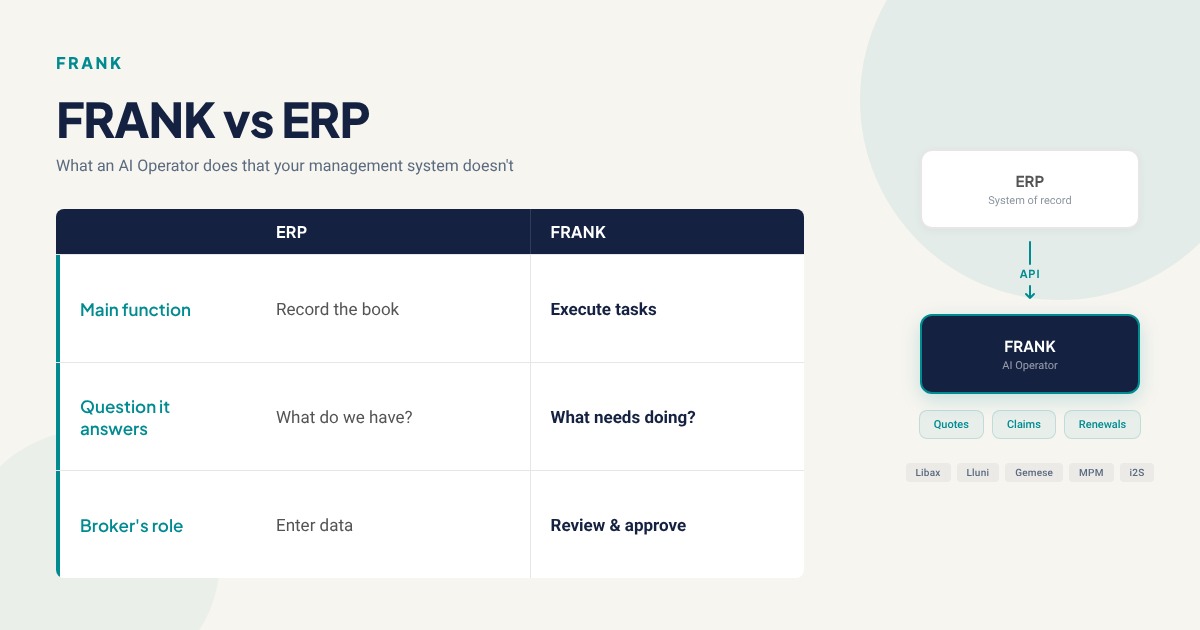
An AI Operator executes tasks end to end. Your management system records them. FRANK connects to Libax, Lluni, Gemese, MPM and i2S, so brokers start using AI without switching systems.
· FRANK · English · Guides
A broker management system is where everything is recorded: clients, policies, receipts, commissions and accounting. It answers the question "what do we have?".
FRANK is an AI Operator. Its AI agents do the work around that record — quotes in insurer portals, claims, emails, WhatsApp and renewals — and the broker approves every result.
FRANK does not replace your management system. It connects to it, starts from the client and policy data already there and works on top of it.
FRANK integrates with management systems such as Libax, Lluni, Gemese, MPM and i2S, and can connect to many others. Brokers do not have to switch systems to start using AI.
Key takeaways
- Your management system is your brokerage's system of record. It answers "what do we have?".
- FRANK is an AI Operator. It answers "what needs to be done?" and executes tasks end to end.
- FRANK does not replace the management system. It connects to it and works from the data already there.
- FRANK integrates with Libax, Lluni, Gemese, MPM and i2S, and can connect to many other systems.
- Brokers do not have to switch systems to start using AI.
Monday, 9 a.m. The management system shows three renewals coming due, a claim to follow up and a quote request that arrived by WhatsApp on Saturday. Everything is recorded. Nothing is done.
For the quote, someone looks up the client in the management system and copies the data into the first insurer's portal, then the second, then the third. They collect the prices, prepare the proposal and reply. The client asks for a lower deductible, and the round through the portals starts again. The claim means going to the insurer's portal every few days until it is closed. The renewals mean pulling the list, re-quoting each policy and preparing the proposal before the date.
The management system was present at every step. It did none of them.
After "will AI replace brokers?", the question we hear most is: do we have to change our management system to use FRANK? The short answer is no. Here is why, and how the two work together.
What is a broker management system?
A broker management system is the software where a brokerage keeps its book of business: clients, policies, premiums, collections, commissions, accounting and the regulatory reports that depend on them. It is the brokerage's system of record. A good management system answers, at any moment, "what do we have?".
In Portugal the term is almost always ERP. In the UK it is called a broker management system (BMS) and in the United States an agency management system (AMS). The function is the same.
These systems tend to stay for many years. i2S Brokers has been developing software for insurance brokers since 1984, and Libax since 2010. Most brokerages chose their management system years ago, and that is where their entire history lives.
What is an AI Operator?
An AI Operator is a set of AI agents that executes operational tasks end to end: quotes in insurer portals, claims filing and follow-up, emails, WhatsApp messages and renewals. It works from the data already in the management system. Unlike a chatbot, it does not just answer questions.
What is the difference between a management system and an AI Operator?
| Broker management system | FRANK (AI Operator) | |
|---|---|---|
| Main function | Record and organize the book of business | Execute tasks end to end |
| Question it answers | What do we have? | What needs to be done? |
| Data it works with | Structured fields: clients, policies, receipts, commissions | Emails, PDFs, photos, WhatsApp messages, insurer portal screens |
| Where it works | Inside its own application | In the management system, insurer portals, email and WhatsApp, among others |
| Broker's role | Enters and looks up data | Reviews and approves |
| What it produces | A complete record, accounting, reports | Quotes, filed claims, prepared replies, renewals ready to send |
Applied Systems, one of the largest management system vendors in the United States, describes the same shift as management systems moving "from systems of record to systems of action". For us, these are two systems with different functions that work together, not one turning into the other.
Why do hours get lost between systems?
Hours are lost in the handoffs between systems: the management system, insurer portals and email do not talk to each other, and people are the ones copying data from one to the next. For two decades, broker software was built to record and organize information. Each tool covers part of the process: the management system holds the book of business, insurer portals handle quotes and claims, email and phone bring the requests. The link between them is still made by people, moving data by hand from one system to another.
That is where AI saves the most time. Two brokerages using FRANK at maturity ran between 12,400 and 13,100 quotes per month with AI agents, between September and October 2026. On quotes alone, each one avoided between 930 and 980 hours of manual work per month — the equivalent of more than 6 full-time people. For a smaller brokerage the math works the same way: every 100 quotes correspond to about 7.5 hours of manual work avoided.
The rest of the market shows the same gap, seen from the other side. In Liberty Mutual's 2026 study of nearly 1,200 agency principals and staff in the United States, 65% of agents had used AI at work in the past year, but only 14% said their agency had implemented an AI tool. The Big "I" found that just 8% of agencies had AI integrated into daily work.
The reason is practical. If the broker has to copy client data from the management system, paste it into a chatbot, check the result and paste it back, the time saved shrinks and the tool stops being used. AI pays off when it works directly with the data already in the management system.
Does FRANK replace the management system?
FRANK is not a management system, and we did not set out to build one. From the start, we decided to work with the management systems brokers already use, for four reasons.
The data is already there. Clients, policies and renewal dates live in the management system. When FRANK starts from that data, nobody re-enters it, and every task begins from the same record accounting uses.
Switching costs too much. Changing management systems means migrating years of history, rebuilding reports and slowing part of the operation for months. "Anytime you rip out a legacy system, or any system you've used for 10, 20, 30 years, that's viewed as a risk," in the words of Eric Purdy from Rival Insurance Technology. A brokerage should not have to take that risk to start using AI.
The team knows its system. People use the management system every day. A tool that fits into it gets adopted faster than one that forces a change.
Each piece should do one thing well. In our first whitepaper we described insurance technology moving from rigid "steel frames" to modular "Lego bricks". The management system is one of those pieces, and the companies that build them know the administrative side of broking far better than a young company. Working alongside them makes FRANK better than working apart from them.
How does FRANK work with your management system?
1. Connect. The brokerage authorizes a secure API connection between its management system and FRANK.
2. Map. Clients, policies, documents and tasks from the management system are mapped in FRANK.
3. Fill. FRANK fills in quotes and forms with the data already in the management system.
4. Execute. AI agents handle quotes, renewals, claims and inquiries.
5. Approve. The broker reviews every result before it reaches any client.
> "The integration between the management system, which holds the portfolio data, and FRANK, the AI assistant that automates tasks, represents a crucial synergy. It makes day-to-day work more agile and efficient."
>
> António Castro, CEO of FRANK
Management systems are also opening up to AI on their side. In August 2026, Libax made its system available to AI assistants such as ChatGPT and Claude through the Model Context Protocol (MCP), starting with client record lookups. Its CEO, Hugo Gonçalves, explained that the goal is "to reduce the number of manual operations needed to carry out administrative tasks and book-of-business management". It points in the same direction as ours: the management system stays the record, and AI works on top of it.
Which management systems does FRANK integrate with?
FRANK integrates with five broker management systems:
- Libax (Libax, Portugal)
- Lluni (Lluni, Portugal)
- Gemese (Milenia, Portugal)
- MPM (MPM Software, Spain)
- i2S (i2S Brokers, Portugal)
The partnerships with Lluni and Gemese were announced in late 2025. FRANK also connects to Gmail, Outlook, Google Calendar, WhatsApp and Salesforce, and management system data can also be imported via CSV. FRANK is constantly evolving, adapts to different software and can even connect to in-house systems built by the brokerage itself.
Questions to ask before connecting an AI tool to your management system
- Does it work with your management system, or do data have to be copied in and out?
- What data does it read, and does it write anything back?
- Is there a person approving every result before it reaches a client?
- Is every action logged and visible to the brokerage?
- Where is data hosted, and is it used to train AI models?
- What happens to your management system if you stop using the tool tomorrow?
At FRANK, the answers are these. FRANK reads what the brokerage authorizes. The broker approves everything before it reaches a client. Every action is logged and can be reviewed. Data is hosted in the EU and is not used to train AI models, and a data processing agreement under GDPR is available. If you stop using FRANK, your management system stays exactly as it was.